Strengthening Inclusive Climate Governance and Community Resilience in Jigawa State
In 2025 Women Environmental Programme (WEP) implemented an eight-month intervention titled “Addressing Climate Change Vulnerabilities Through Inclusive Governance and Community Resilience in Jigawa State” under the Partnership for Agile Governance and Climate Engagement (PACE) programme, funded by the UK Foreign, Commonwealth and Development Office (FCDO). The project aimed to strengthen participatory climate governance and improve the adaptive capacity of vulnerable populations—particularly women and persons with disabilities (PWDs)—in two high-risk LGAs in Jigawa State through inclusive governance and climate-smart agriculture.
Project implementation commenced with state-level stakeholder consultation and advocacy, engaging key ministries and MDAs, including the Ministries of Economic Planning and Budget, Women Affairs, Agriculture, and the Jigawa Agricultural and Rural Development Authority (JARDA). These engagements enabled the collection of data across 17 LGAs where women are engaged in dry-season farming. A subsequent multi-stakeholder consultation, involving CSO coalitions and relevant actors, led to the selection of Yankwashi and Buji LGAs as the project implementation areas.
Further local government advocacy visits were conducted in the selected LGAs, engaging LGA Chairmen, agricultural coordinators, traditional leaders, security agencies, women leaders, and PWD representatives, securing community buy-in and institutional support for the project.
To strengthen civil society engagement, WEP organised a two-day “From Policy to Advocacy” workshop, which equipped CSOs with practical advocacy and negotiation skills for promoting inclusive climate and environmental governance. Participants reported improved understanding and capacity to engage policymakers effectively.
The project also implemented a training of enumerators, followed by a baseline and needs assessment of selected women groups to identify priority agricultural needs. This informed the design of project interventions. Additionally, a three-day Training of Trainers (ToT) was conducted for agricultural extension workers, covering climate change, organic input production, climate-smart crop production, farm communication, and agribusiness.
Subsequently, women farmers in Yankwashi and Buji LGAs participated in two-day practical trainings focused on climate change mitigation, climate-smart agriculture, and the production of organic fertilizers and pesticides. Beneficiaries expressed significant knowledge gains, with several noting changes in farming practices and perceptions of local resources.
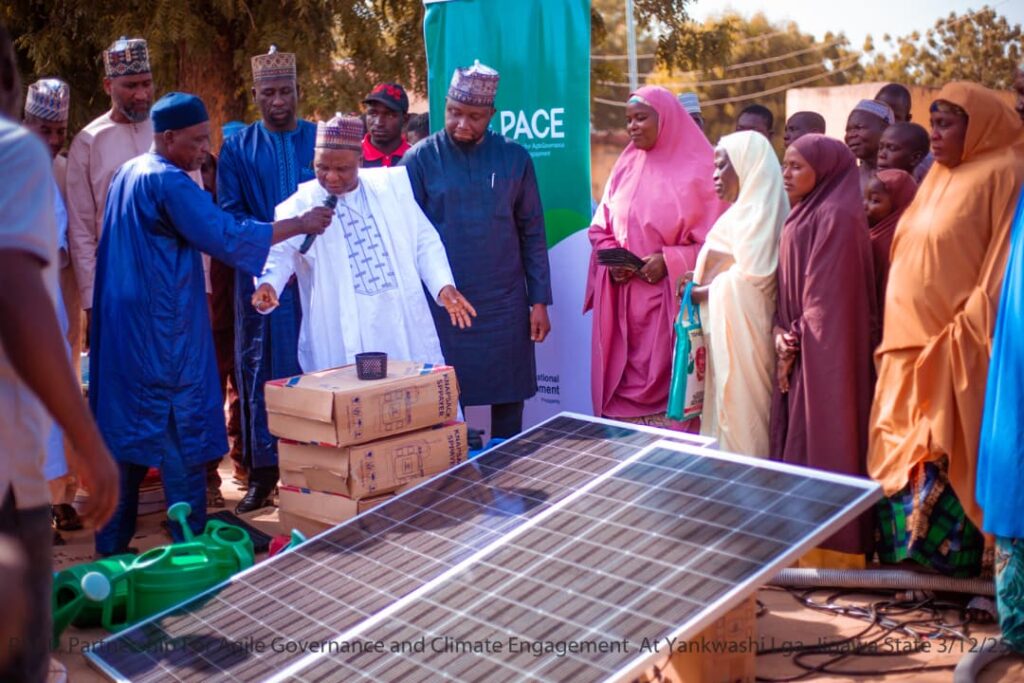
The project concluded with the distribution of agricultural inputs to 200 women farmers, including solar-powered irrigation machines, seed trays, seedlings, and watering cans, to support sustainable dry-season farming and promote safe, organic agricultural production.
Overall, the eight-month PACE intervention strengthened collaboration with CSOs, improved inclusive climate governance, and enhanced the resilience and livelihoods of women farmers in Jigawa State through sustainable agroecological practices.