
Traditional Rulers Enforce Bye-Laws to Save Ebonyi Forests
The traditional ruler of Okposi community, Eze (Dr.) Onyibe Agwu points at the towering trees of the ancient Egbu Forest from his compound, his voice softens. “These trees have stood for over 500 years. They are part of our history, our identity. To lose them is to lose ourselves,” he says. For generations, the people of Okposi protected sacred trees for cultural reasons, but in recent years deforestation, bush burning, and illegal logging threatened to erase centuries of heritage.
That changed in 2024 when the Green Livelihoods Alliance (GLA) – Forests for a Just Future Programme, implemented by the New Neighbourhood Environment Watch (NEW) Foundation with support from the Women Environmental Programme (WEP), began sensitizing Ebonyi communities on the link between forest protection, human health, and climate resilience. Through community dialogues, sensitization training, began to see that protecting ancient trees was not just cultural, it was essential for survival.
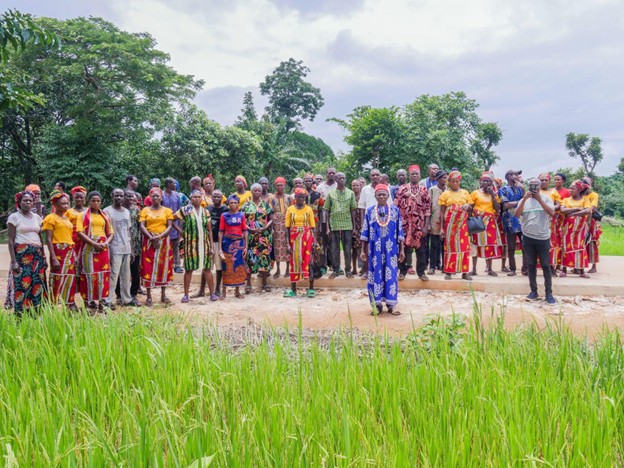
The impact was immediate. In Okposi, the traditional council passed bye-laws fining offenders ₦20,000 for cutting protected trees, with further sanctions if compliance is ignored. In Ohatekwe-Edda, the traditional ruler, Ezeogo Godwin Nwankwegu, declared that no one may cut a tree without first planting one to replace it. Offenders now face stiff penalties, and three people have already been sanctioned since the laws took effect.
At the state level, officials are taking notice. Dr. Ameachi Joshua Nwinyimagu of the Department of Climate Change, Ebonyi State Ministry of Environment, confirmed that the ministry will work with communities to integrate these bye-laws into formal state policy. This aligns with Nigeria’s broader environmental regulations under the National Environmental Standards and Regulations Enforcement Agency (NESREA) Act of 2007 and the National Environmental (Forest Sector) Regulations of 2014, which prohibit indiscriminate tree cutting without permits and require replacement planting.
For Eze Agwu, this shift means hope. “Before, people thought cutting trees was just normal. Now they know it destroys our land, brings floods, and drives away animals. These new rules are saving our forest and our children’s future,” he says, gesturing to a nearby plantation where his wife planted 2000 palm trees.
The ripple effect is already visible. Communities that once relied on customs alone are now blending tradition with climate science. Awareness of forest preservation is at an all-time high, and illegal logging cases have dropped significantly since the sensitizations began. The Ebonyi State Ministry of Environment has pledged to scale this approach across other local government areas.
What began as cultural preservation has grown into a climate resilience movement. Communities are turning knowledge into action, traditional rulers are enforcing laws, and the state is preparing to back them with formal policy. The story of Okposi and Ohatekwe-Edda shows how local leadership, supported by the GLA programme, can break the vicious cycle of deforestation and climate change, a model that could guide forest governance across Nigeria’s tropical landscapes.